
An Act of Love
Lindsay Joelle on Writing TRAYF
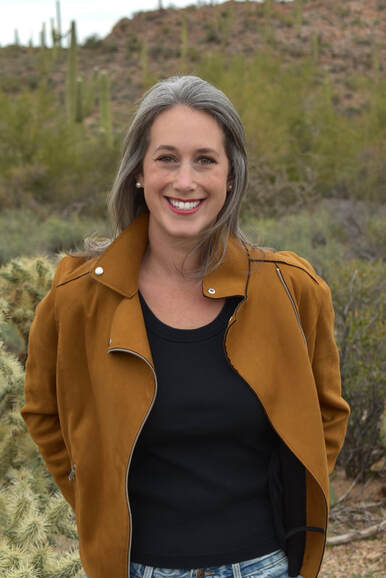
Lindsay Joelle’s play TRAYF returns to Next Act Theatre for the second time in less than 12 months: in December 2025, we held a staged reading of the play, which Lindsay joined us for. She spoke with Producer’s Circle donors before the reading and read stage directions for us on stage. Now that her 1990’s road trip comedy is getting a full staging at Next Act, we sat down with her to catch up and see what she’s excited about in a full production.
What was the inspiration for TRAYF? How did the play come to be?
When I moved to New York City in 2001, one of the first friends I made was a former [Orthodox Jewish] Chabad-Lubavitcher from Crown Heights who left the community in his 20s to start a new, secular life. He’s a wonderful storyteller, and I was always interested in his tales of dipping his toe into the secular world — a covert trip to Blockbuster as a kid or the thrill of trying on a forbidden pair of blue jeans. It made me see with fresh eyes parts of my own world I took for granted. I’m interested in insular communities; learning about their rituals and routines and bringing those stories to the stage. Zalmy and Shmuel in their Mitzvah Tank are fictional characters, but I knew I wanted to tell a story of friendship — of two friends growing up and apart, and the love between them that proves stronger than ideology.
What research did it take to write this play?
Most of my early research was through my friend’s anecdotes, which add up to more than eighteen years of weekend brunches. I also met with rabbis in Crown Heights, talked fedora fashion with a Chasidic milliner, learned proper wrapping technique in a tefillin shop, wandered around Judaica bookstores looking for [tapes of Rebbe speeches], sat in the women’s balcony at 770 (the main synagogue) and boarded a Mitzvah Tank. Though I made it clear that my motive was to write a play, not to increase my level of observance, it seemed I always had a standing invitation to shabbos dinner!
What was easy and what was hard about writing characters whose identities are similar to yours (Jewish), but also different (Chabad)?
When I wrote TRAYF for my MFA thesis, the play culminated in the 1991 Crown Heights Race Riots between the Jewish and Afro-Caribbean communities and the destruction of the Mitzvah Tank. An important realization in the rehearsal process for the World Premiere at Theater J was that the play, which at its core is about a friendship, didn’t need a riot to feel theatrical. The stakes of growing apart from a childhood friend are vital enough and universal. The moments when Shmuel and Zalmy are goofing off and having fun with each other in the Mitzvah Tank when no one’s watching were the best parts to write, and the guys’ jokes and banter came the most easily.
Leah and Jonathan were harder. Leah, because she has so much heavy lifting to do in her one short scene, and probably also because her experiences overlap most with my own; Jonathan because he’s the character I know least — I wanted to honor his discovery of his Jewish roots and the way that pulls him toward the community and structure of organized religion, but those aren’t motivations I’ve experienced in my own life.
Did the staged reading of TRAYF at Next Act affect your feelings about our fully-staged production?
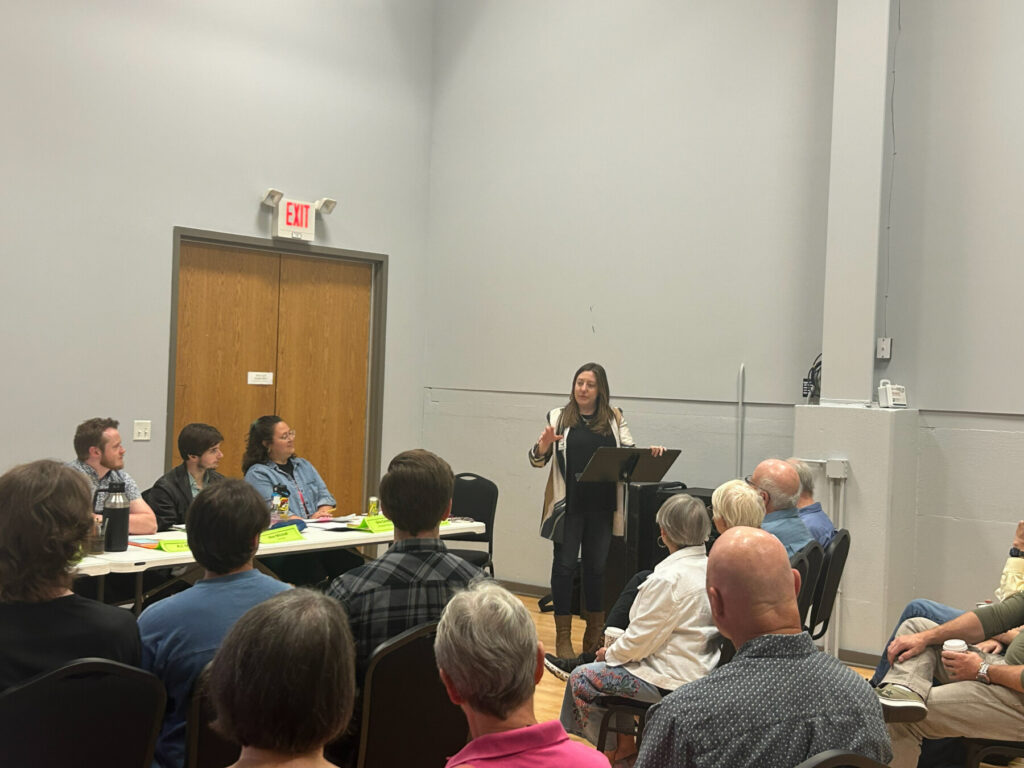
I think Cody’s secret plan for bringing me to Milwaukee for the reading was so that I could mind-meld with Elyse (the director and Associate Artistic Director of Next Act), since I live in Tucson and wouldn’t be present for most of the rehearsal process. It was super easy and joyful to work with Elyse. She had an intuitive understanding of the play, and she’s such an earnest and generous person herself that I knew she’d be able to hone in on that menschy quality within the play. I also had a lot of fun reading stage directions. I come from an acting background, but I’m not usually asked to take an active part in readings of my plays. I really enjoyed experiencing the momentum and energy of the play from on stage with the cast.
Between TRAYF and another of your plays, THE GARBOLOGISTS, you have several plays that call for large vehicles on stage. What interests you about putting these vehicles in your plays?
Two things, really: first, I like the fly-on-the-wall quality of listening in on private conversations in intimate spaces. There’s something about conversations on the road that can make it easier to get into the good stuff when you’re watching the scenery go by or listening to the radio, and in both the plays you mentioned, a truck is the liminal space between the public-facing moments on the job. I’m interested in what people talk about behind the scenes, in the break room, or in transit.
Especially in THE GARBOLOGISTS, which follows two sanitation workers from different backgrounds on a garbage route, I was also thinking of the truck as a space of forced proximity, where they are required to interact in a way that they wouldn’t do voluntarily in the outside world.
[Editor’s note: Next Act Artistic Director Cody Estle directed a production of Lindsay’s THE GARBOLOGISTS at Northlight Theatre in 2023!]
What do you think TRAYF says to an audience right now?
In my research, I was particularly moved by the Chabad belief that love is an action; that the world is imperfect, and it’s not by divine intervention, but through dedicated and systematic acts of love toward ourselves and each other that we will repair it. I think that’s a message for all of us right now — that we can’t afford to be complacent, whether it’s the destruction of our shared natural resources or the abuse of the rights and freedoms belonging to those inside and outside our own communities. We activate our love by living our values.
In terms of the way in which writing TRAYF was my own act of love, I’d say this: Zalmy and Shmuel are just like any 19-year-old best friends. They drive a cool truck, talk about girls, obsess over music — even though their truck is a Mitzvah Tank, their dates are arranged by a matchmaker, and their music is chanted in Yiddish by a 90-year-old Rebbe. If at first their suits and beards make them appear different and strange, and then in the next 90 minutes we ride with them, experiencing the world as they do, when we leave the theater maybe we’re a little changed. A little more primed to focus on what we have in common instead of what divides us. And wouldn’t that be a mitzvah?
TRAYF runs September 16 through October 4, 2026 at Next Act Theatre. Get tickets now at nextact.org or call (414) 278-0765.